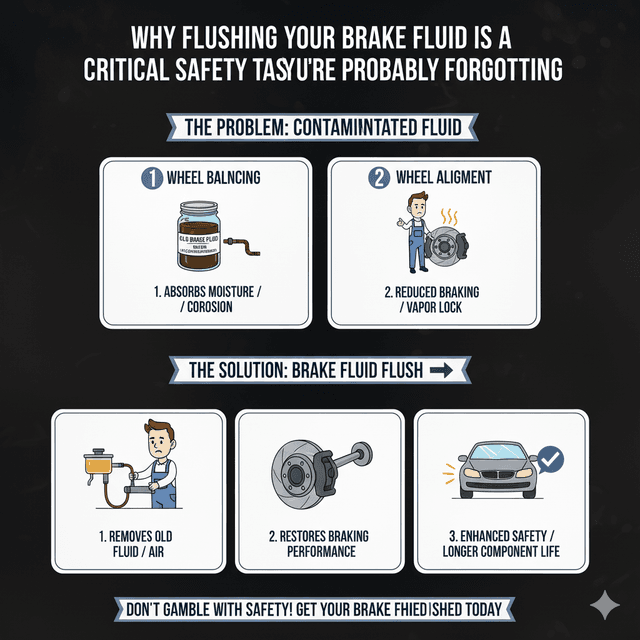
Why Flushing Your Brake Fluid is a Critical Safety Task You're Probably Forgetting

Drvyn
Content Writer
When we think about brake maintenance, our minds immediately go to brake pads and rotors. While these are certainly critical, there's a silent and often-neglected component that is just as vital for your safety: the brake fluid. Over time, this fluid degrades, and failing to change it can lead to a gradual or even sudden loss of braking performance. Let's explore why a brake fluid flush is a non-negotiable part of your vehicle's safety maintenance.
What Does Brake Fluid Do?
Your car's braking system is a hydraulic system. When you press the brake pedal, you are pushing a plunger in the master cylinder, which pressurizes the brake fluid. This incompressible fluid travels through the brake lines and forces the brake calipers to clamp the brake pads against the rotors, slowing the car down. For this to work, the fluid must be free of any compressible substances.
The Problem: Moisture Contamination
Brake fluid is 'hygroscopic,' which is a scientific way of saying it absorbs moisture from the surrounding air. Over time, tiny amounts of water seep into the system through microscopic pores in the brake lines and past seals. Even a small amount of water in the brake fluid—as little as 3%—can have two dangerous effects:
1. It Lowers the Boiling Point
Braking generates a massive amount of heat. Fresh, clean brake fluid has a very high boiling point (often over 230°C). Water, however, boils at 100°C. If your brake fluid is contaminated with water, the intense heat from prolonged or hard braking (like driving down a mountain) can cause that water to boil and turn into steam. Steam, unlike liquid, is highly compressible. This leads to a terrifying condition called 'brake fade,' where the brake pedal suddenly feels soft and goes to the floor with little to no braking effect.
2. It Causes Internal Corrosion
Water in the brake system leads to rust and corrosion of sensitive and expensive components from the inside out. This includes the brake lines, calipers, and especially the delicate valves in the ABS control module. Repairing a corroded ABS module can be extremely expensive, and a rusty brake line can burst under pressure, leading to complete brake failure.
What is a Brake Fluid Flush?
A brake fluid flush is not just 'topping up' the fluid. It's a comprehensive service where a technician uses specialized equipment to push all the old, dark, contaminated fluid out of the entire system—from the master cylinder all the way to the calipers at each wheel—while simultaneously replacing it with fresh, new fluid. This ensures the entire system is free of moisture and contaminants.
How Often Should It Be Done?
Most vehicle manufacturers recommend a brake fluid flush every 2 to 3 years, regardless of the kilometers driven. The moisture absorption happens over time, whether the car is driven or not. It's one of the most commonly overlooked maintenance items, but one of the most critical for your safety.
Your ability to stop is not negotiable. Don't neglect the silent hero of your braking system. A brake fluid flush is a simple, inexpensive service that restores braking performance and prevents costly future repairs. Check your service history, and if it's been over two years, book a professional brake fluid flush with Drvyn today.
Enjoyed this article?
Share it with your network
Join the Conversation
Share your thoughts and insights about this article