Wheel Balancing vs. Alignment: What's the Difference and Why You Need Both

Drvyn
Content Writer
When it comes to smooth driving and tire longevity, the terms 'wheel balancing' and 'wheel alignment' are often used interchangeably, but they refer to two completely different, yet equally important, services. Understanding the distinction is key to diagnosing ride quality issues and properly maintaining your vehicle. Let's break down the difference and explain why your car needs both.
Wheel Balancing: Correcting Weight Imbalance for a Smooth Ride
What it is: Wheel balancing addresses the weight distribution of the tire and wheel assembly. No tire and wheel are perfectly balanced from the factory; there will always be slight imperfections and heavy spots. An imbalance causes the wheel to wobble or 'hop' up and down as it spins, especially at higher speeds.
The Symptoms: The most common symptom of an imbalanced wheel is a vibration that you can feel in the steering wheel, which typically appears at a certain speed (e.g., 80-90 km/h) and may smooth out at higher speeds. You might also feel a vibration through the seat or floor if the rear wheels are imbalanced.
The Process: A technician uses a specialized machine to spin the wheel and identify the heavier spots. They then apply small, precisely measured counterweights to the wheel rim to even out the weight distribution, ensuring a smooth, vibration-free rotation.
When to do it: You should have your wheels balanced any time you get new tires, when you have a puncture repaired, or whenever you notice a new vibration.
Wheel Alignment: Adjusting Wheel Angles for Straight Tracking and Even Wear
What it is: Wheel alignment, also known as tire alignment, doesn't involve the wheels themselves but rather the car's suspension. It's the process of adjusting the angles of the wheels (camber, caster, and toe) so that they are perfectly parallel to each other and perpendicular to the ground, according to the manufacturer's specifications.
The Symptoms: The classic signs of misalignment are your car pulling or drifting to one side when you're trying to drive straight, or your steering wheel being off-center. The most costly symptom is rapid and uneven tire wear, often on the inner or outer edges of the tires.
The Process: A technician uses a high-tech alignment machine with lasers and sensors to measure the suspension angles precisely. They then make adjustments to the steering and suspension components to bring the angles back into the correct specification.
When to do it: Have your alignment checked annually, after installing new tires, after a hard impact with a pothole or curb, or if you replace any suspension parts.
The Bottom Line: Two Different Problems, One Goal
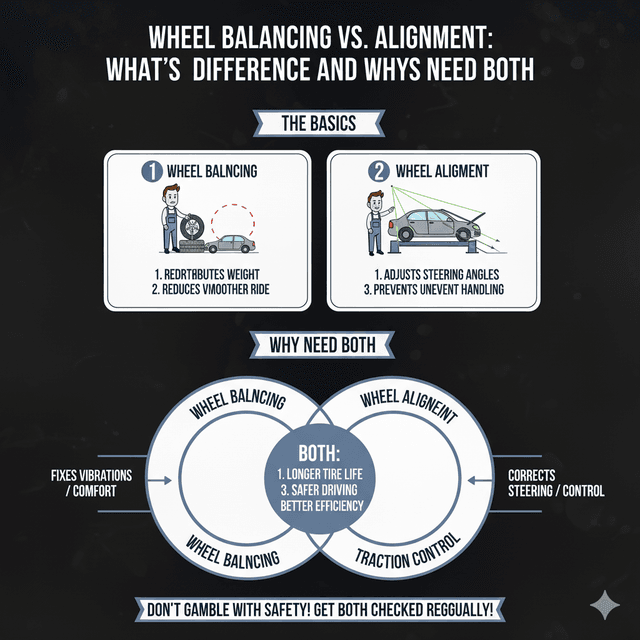
Think of it this way: Balancing ensures your wheels rotate smoothly, while Alignment ensures they travel straight.
- Balancing solves vibration issues.
- Alignment solves tracking and uneven wear issues.
Neglecting either service will result in a poor driving experience and, more importantly, will drastically shorten the life of your expensive tires. For a safe, comfortable ride and maximum tire lifespan, you need both.
Experiencing vibrations or pulling? It's time for a professional check. Our workshops are equipped with advanced balancing and alignment machines to service your car with precision. Book your wheel service with Drvyn today and get your car rolling smoothly again.
Enjoyed this article?
Share it with your network
Join the Conversation
Share your thoughts and insights about this article