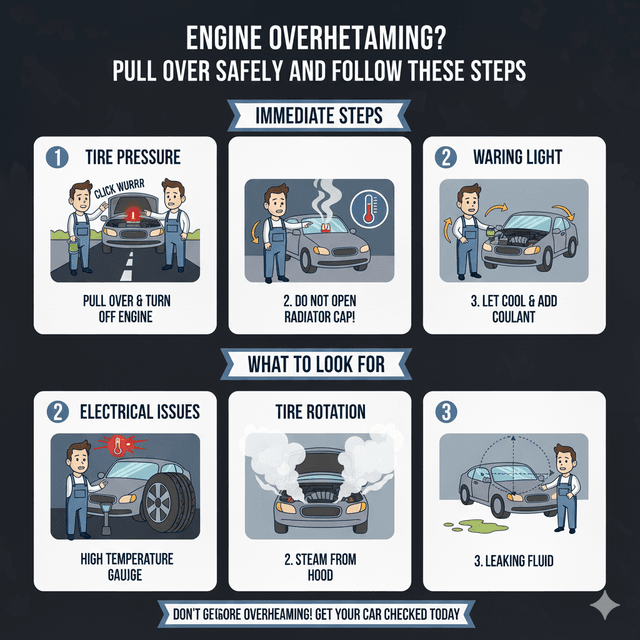
Engine Overheating? Pull Over Safely and Follow These Steps

Drvyn
Content Writer
Seeing the temperature gauge on your dashboard spike into the red zone, or getting a high-temperature warning light, is a stressful and potentially catastrophic event for your car. An overheating engine is a serious problem that can cause permanent damage if not handled correctly and immediately. Knowing the right steps to take can be the difference between a minor repair and a massive engine rebuild bill. Here's exactly what to do if your engine starts to overheat.
Step 1: Immediately Reduce Engine Load
The very first thing you should do is turn off the Air Conditioning. The AC compressor puts a significant load on the engine. Next, turn your cabin fan on high and switch the temperature control to maximum heat. This may seem incredibly counterintuitive and will make the cabin very uncomfortable, but your car's heater core acts like a small, secondary radiator. Turning on the heat helps pull heat away from the engine coolant and into the cabin, which can provide a small but crucial amount of cooling as you find a safe place to stop.
Step 2: Find a Safe Place to Pull Over and Stop
As soon as you notice the temperature rising, your priority is to get off the road safely. Do not try to 'push through' and make it to your destination. Continuing to drive an overheating engine can cause metal components like pistons, cylinders, and the cylinder head to expand beyond their limits, leading to them warping or cracking. This is often terminal engine damage.
Step 3: Turn Off the Engine and Allow a Long Cool-Down
Once you are safely stopped, turn off the engine completely. If you can, open the bonnet to allow heat to dissipate more quickly, but be extremely cautious as the entire engine bay will be incredibly hot. Do not attempt to touch anything. You must let the engine cool down for a minimum of 45-60 minutes. It needs to be cool enough to touch before you can safely proceed.
Step 4: DO NOT, Under Any Circumstances, Open the Radiator Cap
This is the most critical safety warning. The cooling system is highly pressurized when the engine is hot. The coolant's boiling point is well above 100°C under this pressure. Opening the radiator or coolant reservoir cap will cause the pressure to release suddenly, causing boiling hot coolant and steam to erupt violently. This can cause severe, life-altering burns. Wait until the engine is completely cool to the touch before even considering opening the cap.
Step 5: Check the Coolant Level (Only When Completely Cool)
Once the engine has fully cooled, you can safely check the coolant level in the translucent plastic overflow tank. There will be 'MIN' and 'MAX' lines on it. If it's empty or very low, that's almost certainly the reason for the overheating. If you have the correct type of coolant with you, you can top it up. In an emergency, you can add plain water as a temporary measure to get you to a service center. However, remember that a low coolant level means there is a leak somewhere in the system.
Step 6: Determine the Cause and Call for Professional Help
An overheating event is a symptom of an underlying failure. The cause could be a coolant leak from a hose or radiator, a faulty thermostat stuck in the closed position, a failing water pump, a broken radiator fan, or a blockage in the system. Even if you add coolant and the temperature seems stable, the original problem still exists and it will overheat again. The only safe option is to have the car inspected by a professional mechanic.
An overheating engine is an emergency for your car. Don't risk permanent damage. Our expert technicians can diagnose and repair all cooling system issues, from simple leaks to complex component failures. If your car has overheated, contact Drvyn for reliable service and get back on the road safely.
Enjoyed this article?
Share it with your network
Join the Conversation
Share your thoughts and insights about this article