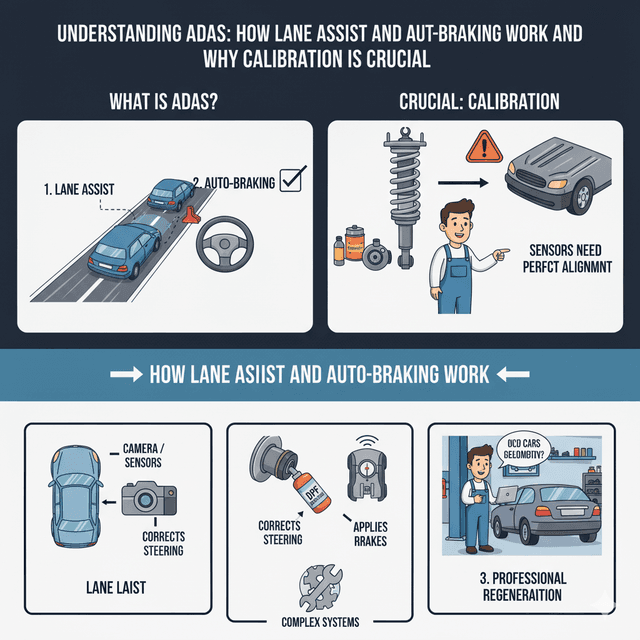
Understanding ADAS: How Lane Assist and Auto-Braking Work and Why Calibration is Crucial

Drvyn
Content Writer
Modern cars are becoming safer than ever, thanks to the rapid integration of Advanced Driver-Assistance Systems, commonly known as ADAS. These are not features of a distant, self-driving future; they are active in many new cars on Indian roads today. Understanding what ADAS is, how its key features work, and its maintenance needs is crucial for any modern car owner.
What is ADAS?
ADAS is a suite of intelligent safety technologies designed to assist the driver and reduce the risk of human error, which is the leading cause of accidents. These systems use a network of sensors—such as cameras mounted on the windshield, radar units in the grille, and ultrasonic sensors in the bumpers—to constantly monitor the vehicle's surroundings. A central computer processes this data in real-time to provide warnings or even take automated action.
Common ADAS Features Explained
1. Autonomous Emergency Braking (AEB)
How it works: Using radar and/or camera data, the AEB system calculates the distance and closing speed to the vehicle or obstacle ahead. If it detects an imminent collision and the driver has not applied the brakes, it will first provide a warning (a beep or a visual alert). If the driver still doesn't react, the system will automatically apply the brakes with full force to prevent or mitigate the impact.
2. Lane Keep Assist (LKA) / Lane Departure Warning (LDW)
How it works: A forward-facing camera on the windshield 'reads' the lane markings on the road. The LDW system will provide an audible or steering wheel vibration alert if you unintentionally drift out of your lane without signaling. The more advanced LKA system will go a step further and apply gentle steering torque to nudge the vehicle back into the center of the lane.
3. Adaptive Cruise Control (ACC)
How it works: This is an advanced form of cruise control. You set your desired speed, and the system uses radar to lock onto the vehicle ahead. It will automatically maintain a pre-set following distance by adjusting your car's speed, braking when the car in front slows down, and accelerating back to your set speed when the path is clear.
4. Blind Spot Monitoring (BSM)
How it works: Radar sensors in the rear bumper monitor the areas in the adjacent lanes that are typically in your blind spot. If a vehicle is detected, a warning light will illuminate in your side-view mirror. If you activate your turn signal while a car is in your blind spot, the system will usually provide a more urgent audible alert.
The Critical Importance of ADAS Calibration
The sensors used by ADAS are extremely precise and need to be perfectly aligned to function correctly. This alignment is called calibration. Several common repair procedures can throw these sensors out of alignment, requiring a professional recalibration. These include:
- Windshield Replacement: The forward-facing camera is mounted on the windshield. Replacing the glass requires the camera to be recalibrated to ensure it's 'seeing' the road correctly.
- Wheel Alignment or Suspension Work: Changing the car's ride height or alignment alters the vehicle's angle relative to the road, which can affect the radar and camera's calculations.
- Collision Repair: Any repair work on bumpers or the front grille, even from a minor fender-bender, can misalign the radar sensors, requiring recalibration.
An uncalibrated ADAS system is a dangerous ADAS system. It can fail to react when needed or, worse, react incorrectly (e.g., braking for no reason). If your ADAS-equipped car needs a windshield replacement or collision repair, ensure the workshop is equipped with the specialized tools for ADAS calibration. Trust Drvyn's network of modern, certified garages.
Enjoyed this article?
Share it with your network
Join the Conversation
Share your thoughts and insights about this article