The Ultimate Guide to Tire Maintenance: Pressure, Rotation, and Alignment

Drvyn
Content Writer
Your tires are your car's only connection to the road, making their maintenance absolutely critical for safety, handling, comfort, and fuel efficiency. Proper tire care is a simple, proactive way to extend the life of your expensive tires and ensure your car performs as it should. Mastering the three pillars of tire maintenance—Pressure, Rotation, and Alignment—is essential for every car owner.
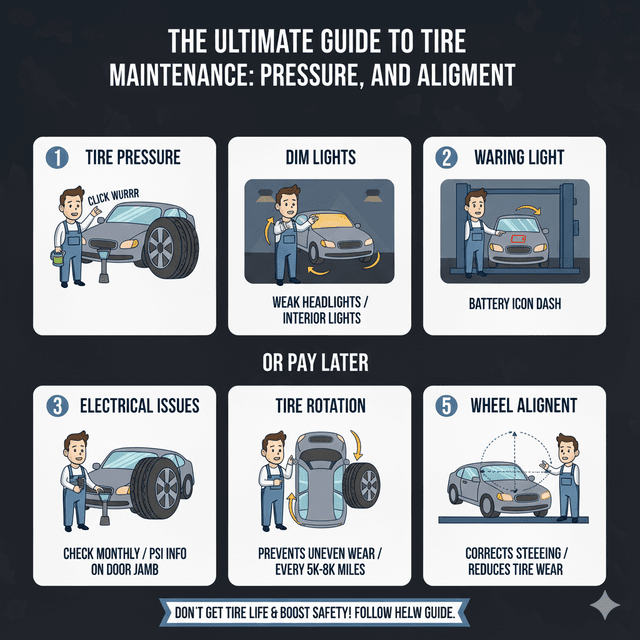
1. Tire Pressure: The Foundation of Safety and Efficiency
Why it Matters: Incorrect tire pressure is a leading cause of tire failure and blowouts. Under-inflation is the bigger danger; it causes the tire's sidewalls to flex excessively, building up dangerous levels of heat that can lead to catastrophic failure. It also increases rolling resistance, which can reduce your fuel economy by several percent. Over-inflation, on the other hand, reduces the tire's contact patch with the road, leading to poor grip, a harsh ride, and rapid wear in the center of the tread.
How to Do It: Check your tire pressure at least once a month, and always before a long trip. Do this when the tires are 'cold' (i.e., haven't been driven for at least a few hours). Use a reliable pressure gauge and inflate them to the PSI recommended on the sticker inside your driver's side doorjamb or in your owner's manual. The pressure listed on the tire's sidewall is the maximum pressure, not the recommended operating pressure.
2. Tire Rotation: Promoting Long and Even Wear
Why it Matters: The tires on your vehicle wear at different rates due to factors like weight distribution and drivetrain. In a typical front-wheel-drive car, the front tires bear the weight of the engine and handle the forces of steering and braking, causing them to wear down much faster than the rear tires. Rotating your tires—systematically moving them to different positions on the car—ensures that they all wear down evenly, maximizing the lifespan of the entire set.
How Often and What Pattern: A good rule of thumb is to rotate your tires every 8,000 to 10,000 kilometers, or at every other oil change. The rotation pattern depends on your vehicle (FWD, RWD, AWD) and whether your tires are directional. A professional technician will know the correct pattern for your car.
3. Wheel Alignment: Ensuring Your Car Tracks Straight
Why it Matters: Wheel alignment refers to the angles of your wheels relative to each other and to the car's frame (known as camber, caster, and toe). Hitting a significant pothole, bumping a curb, or normal wear and tear on steering components can knock your wheels out of their precise alignment. Misalignment is a primary cause of premature tire death, as it forces the tires to scrub and drag along the road, causing rapid and uneven tread wear.
Signs of Misalignment:
- Your car pulls or drifts to the left or right when you're trying to drive straight.
- Your steering wheel is crooked or off-center when you're driving in a straight line.
- You notice uneven or 'feathered' wear on the inner or outer edges of your tires.
When to Check: You should have your alignment checked by a professional once a year, or any time you install new tires, replace suspension parts, or notice any of the symptoms above.
Proper tire care is a simple but powerful way to improve your car's safety, handling, and running costs. Our technicians are equipped to handle all your tire needs, from pressure checks and rotations to precise, computerized wheel alignments. Book your comprehensive tire service with Drvyn today.
Enjoyed this article?
Share it with your network
Join the Conversation
Share your thoughts and insights about this article