Shock Absorbers vs. Struts: What's the Difference?

Drvyn
Content Writer
When discussing your car's suspension and ride quality, you'll often hear the terms 'shocks' and 'struts' used. Many people use them interchangeably, but they are not the same thing. While both serve a similar primary function, they have different designs and roles within the suspension system. Understanding the difference can help you better understand your car's needs when it's time for a replacement.
The Shared Function: Damping
Both shock absorbers and struts are hydraulic damping devices. Your car's springs are what actually absorb the impact from bumps in the road and support the vehicle's weight. However, a spring, by its nature, will continue to bounce up and down after being compressed. The job of the shock or strut is to control and dampen these oscillations, keeping the tire firmly on the ground and preventing the car from continuing to bounce like a pogo stick after hitting a bump. A car with worn shocks/struts will feel overly bouncy and floaty.
Shock Absorbers: A Simple Damping Component
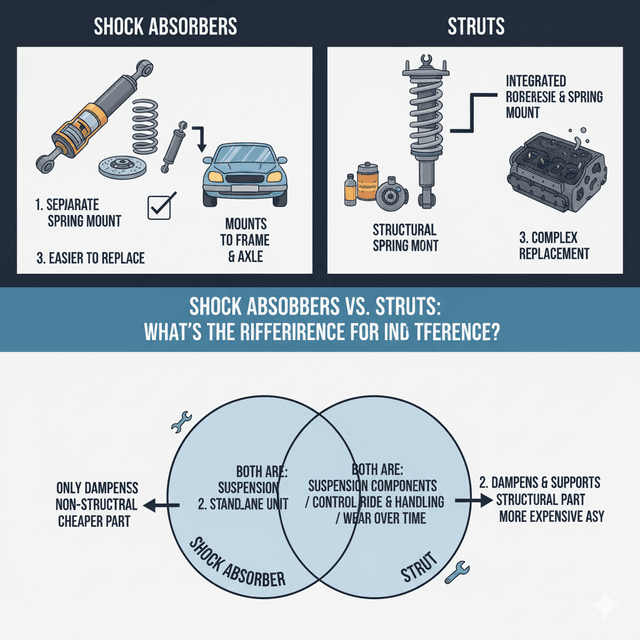
What they are: A shock absorber is an independent component within the suspension. It is essentially a hydraulic piston-in-a-tube that does only one thing: dampen the movement of the spring. It is not a structural part of the suspension; it can be removed, and the car will still be standing on its springs (though it would be dangerously undriveable).
Where they're found: You'll typically find shock absorbers on vehicles with suspension designs where the spring is mounted separately, such as on the rear of many cars and SUVs, or on older vehicles with double-wishbone suspension setups.
Struts: A Structural Suspension Component
What they are: A strut is a much more complex and integral component. It is a shock absorber and a coil spring combined into a single structural unit. A strut assembly not only provides damping like a shock absorber, but it also serves as a structural part of the suspension, supporting the vehicle's weight. Furthermore, it acts as a pivot point for the steering system.
What this means: Because a strut is a structural component, replacing it is a more involved job. Crucially, any time a strut is replaced, the vehicle will require a wheel alignment afterwards, as removing the strut disturbs the suspension's alignment angles. This is not typically required when replacing only a shock absorber.
Where they're found: The MacPherson strut is the most common type of front suspension on the vast majority of modern front-wheel-drive cars, from hatchbacks to sedans and crossovers.
How to Know Which Your Car Has?
The easiest way to know is to consult your owner's manual or a professional mechanic. A general rule of thumb is that if your car has front-wheel drive, it almost certainly has struts at the front. The rear suspension can have either struts or a separate shock and spring setup.
When to Replace Them?
The signs of wear are the same for both shocks and struts:
- A bouncy, unstable, or rough ride.
- The car's front end 'nose-diving' during braking.
- Excessive body roll or swaying during turns.
- Uneven, 'cupped' wear on your tires.
- Visible fluid leaking from the unit.
Because they wear out gradually, it's a good practice to have them inspected after 80,000 kilometers.
Whether your car has shocks, struts, or a combination of both, they are vital for a safe and comfortable ride. If you're experiencing poor ride quality, it's time for an inspection. Book a suspension check-up with Drvyn's experts to determine the health of your shocks and struts.
Enjoyed this article?
Share it with your network
Join the Conversation
Share your thoughts and insights about this article