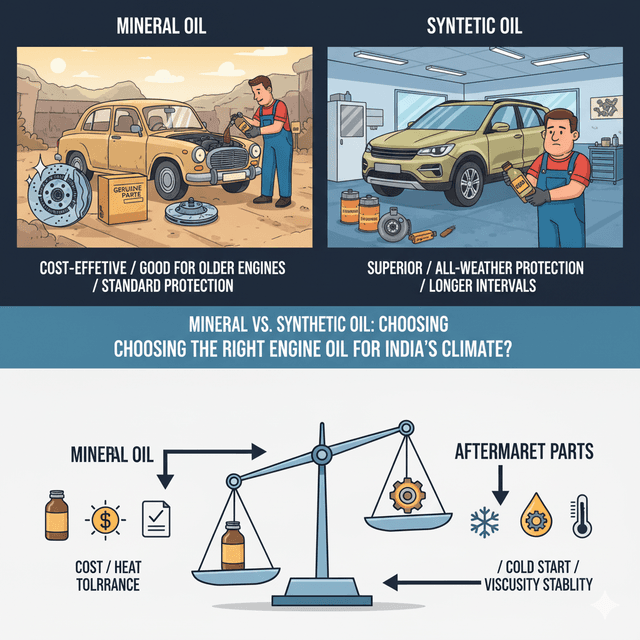
Mineral vs. Synthetic Oil: Choosing the Right Engine Oil for India's Climate

Drvyn
Content Writer
Choosing the right engine oil is one of a car owner's most important decisions, yet it's often the most confusing. Walking into an auto shop, you're faced with a wall of options: conventional, synthetic blend, full synthetic, and various viscosity grades. In a country like India, with its demanding combination of extreme heat and grueling stop-and-go traffic, the choice of oil is even more critical. Let's break down the difference between mineral and synthetic oil to help you make the best choice.
Mineral (Conventional) Oil: The Traditional Choice
What it is: Mineral oil is the most basic type of engine oil. It is refined directly from crude petroleum. It undergoes a refining process to remove impurities, but its molecules remain inconsistent in size and shape. It has been the standard for decades and provides adequate lubrication under normal operating conditions.
Pros:
- Low Cost: It is the most affordable option.
Cons:
- Breaks Down Faster: It is far more susceptible to thermal breakdown under high heat. In India's hot summers and bumper-to-bumper traffic, mineral oil can degrade quickly, losing its protective qualities.
- Shorter Change Interval: It requires much more frequent oil changes, typically every 5,000-7,000 kilometers.
- Prone to Sludge: It is more likely to form engine sludge and deposits, which can clog vital oil passages.
Full Synthetic Oil: The Modern Standard
What it is: Full synthetic oil also starts from a crude oil base, but it is artificially synthesized and extensively re-engineered in a laboratory. This process allows chemists to create molecules that are uniform in size and shape, and to infuse the oil with a powerful and sophisticated package of additives.
Pros:
- Superior Heat Resistance: This is its biggest advantage for the Indian climate. Synthetic oil can withstand much higher temperatures without breaking down, providing consistent protection even in peak summer traffic.
- Longer Change Interval: It lasts much longer, with change intervals often ranging from 10,000 to 15,000 kilometers, reducing the frequency of services.
- Excellent Engine Cleaning: It contains powerful detergents that actively clean away existing sludge and prevent new deposits from forming.
- Better Performance: It flows better in all conditions, reducing friction and slightly improving fuel economy and engine responsiveness.
Cons:
- Higher Cost: It is significantly more expensive per litre than mineral oil.
What About Synthetic Blend Oil?
A synthetic blend is a mix of mineral and synthetic base oils. It offers better protection and a longer lifespan than conventional oil but doesn't have the full performance of a 100% synthetic oil. It's a good middle-ground option for those looking for an upgrade from mineral oil without the full cost of synthetic.
The Verdict for Indian Conditions
While mineral oil can suffice for older, simpler engines under gentle use, for any modern car (especially turbocharged or high-performance models) driven in India, **full synthetic oil is the clear winner and a worthwhile investment.**
The higher initial cost is often offset by the longer service intervals and, more importantly, the superior protection it provides against the heat and stress of Indian driving. It keeps your engine cleaner and better protected, leading to a longer, healthier engine life and preventing costly repairs down the line. Always use the viscosity grade (e.g., 5W-30, 0W-20) recommended in your owner's manual.
Don't compromise on your engine's lifeblood. The right oil makes all the difference. At Drvyn, we use only high-quality synthetic and synthetic blend oils that meet or exceed manufacturer specifications. Book your next oil change service with us for superior protection.
Enjoyed this article?
Share it with your network
Join the Conversation
Share your thoughts and insights about this article