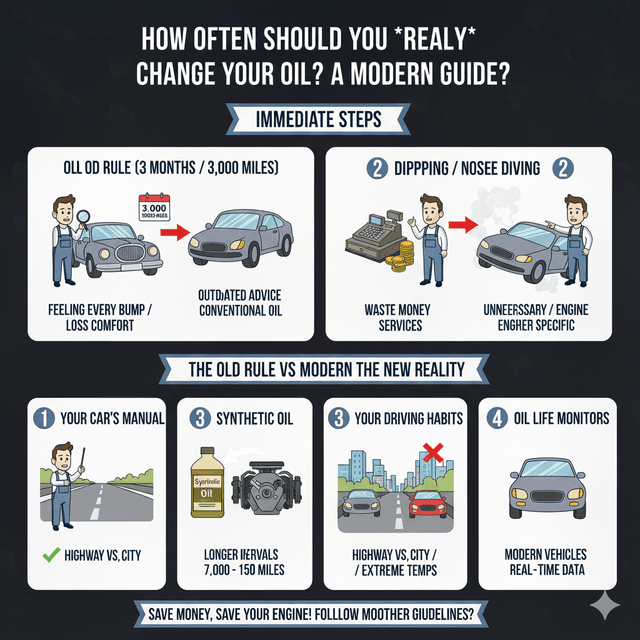
How Often Should You *Really* Change Your Oil? A Modern Guide

Drvyn
Content Writer
The old 'every 5,000 kilometers' rule for oil changes has been a staple of car maintenance advice for decades. It's simple, memorable, and for older cars, it was very good advice. But with today's advanced engines and sophisticated synthetic motor oils, is this rule still relevant, or is it just costing you money? The modern answer is more nuanced. Let's break down the factors that determine the ideal oil change schedule for your specific car.
The Old Rule vs. Modern Engines and Oils
The 5,000 km rule comes from an era when engine technology was less precise and motor oils were simple, conventional-based lubricants that broke down relatively quickly. Modern engines are built with much tighter tolerances and run hotter and more efficiently. To cope with this, motor oils have evolved dramatically. Full synthetic oils are engineered with powerful detergents, anti-wear agents, and viscosity modifiers that allow them to protect engines for much longer periods without degrading.
Factor 1: Your Manufacturer's Recommendation (The Golden Rule)
This is your most important and reliable guide. Your vehicle's owner's manual will specify the recommended oil change interval based on extensive testing by the engineers who designed your engine. This is the ideal starting point. It's not uncommon for modern cars to have manufacturer-recommended intervals of 10,000, 15,000, or even 20,000 kilometers when using the specified grade of synthetic oil.
Factor 2: The Type of Oil You Use
The type of oil in your engine is a critical factor. There are three main types, each with a different lifespan:
- Conventional Oil: The most basic and least expensive mineral-based oil. If you use conventional oil, sticking closer to a 5,000-8,000 km interval is a wise choice.
- Synthetic Blend Oil: A mix of conventional and synthetic base oils, offering better protection and longevity than conventional. They can comfortably last for 8,000-12,000 km.
- Full Synthetic Oil: The highest level of performance, protection, and longevity. Full synthetic oil can last from 12,000 to over 20,000 km in some cases, depending on the car and driving conditions.
Factor 3: Your Driving Habits and Conditions
Your manufacturer's recommendation often assumes 'normal' driving conditions. However, many of us drive in 'severe' conditions without realizing it. You should consider changing your oil more frequently than the manual suggests if your driving regularly includes:
- Frequent short trips: Trips under 15-20 minutes don't allow the engine to reach its full operating temperature, which is necessary to burn off moisture and fuel contaminants that accumulate in the oil.
- Constant stop-and-go traffic: City driving with lots of idling and acceleration puts more stress on the engine and oil than steady highway cruising.
- Extreme conditions: Driving in very hot climates (like much of India), very dusty environments, or extremely cold weather.
- Heavy loads: Regularly towing a trailer or carrying heavy loads in your vehicle.
The Final Verdict: A Personalized Approach
For a modern car using the manufacturer-specified synthetic oil under normal driving conditions, an oil change every 10,000-15,000 kilometers or once a year (whichever comes first, as oil degrades over time) is a safe and effective schedule. However, if your driving is primarily short trips in heavy city traffic, reducing that interval by 20-30% is a smart way to ensure maximum engine life. An oil change remains the single most important piece of maintenance for your engine's health.
Give your engine the clean, high-quality oil it needs to perform its best for years to come. We use premium oils that meet or exceed your manufacturer's specifications. Book your next oil change service with Drvyn for a quick, professional, and transparent experience.
Enjoyed this article?
Share it with your network
Join the Conversation
Share your thoughts and insights about this article