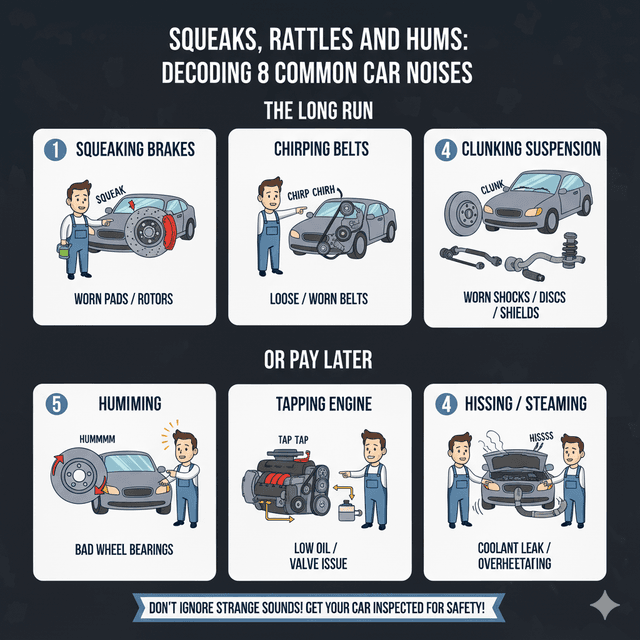
Squeaks, Rattles, and Hums: Decoding 8 Common Car Noises

Drvyn
Content Writer
Cars are complex machines, and over time, they can develop a language of their own—a language of squeaks, rattles, clunks, and hums. Learning to identify these noises can help you catch issues early, preventing more serious damage and ensuring your safety. Don't just turn up the radio; listen to what your car is trying to tell you. Here's a guide to decoding eight common car noises and what they likely mean.
1. A High-Pitched Squeal When Braking
The Sound: A sharp, metallic squeal that occurs when you apply the brakes, which may go away once the brakes are fully pressed.
The Likely Cause: This is the brake pad wear indicator. It's a small metal tab designed to contact the brake rotor when the pads are thin. It's your car's built-in alert system telling you it's time for a brake pad replacement. Don't ignore it, as waiting for it to turn into a grind will be much more costly.
2. A Rhythmic Clicking or Ticking from the Engine
The Sound: A repetitive ticking sound, like a sewing machine, that gets faster as the engine RPMs increase.
The Likely Cause: This often points to an issue in the engine's 'valvetrain'. It could be as simple as low engine oil, which means the upper parts of the engine aren't getting enough lubrication. It could also indicate a worn-out component like a lifter. Check your oil level immediately. If the level is fine, the noise warrants a professional diagnosis.
3. A Deep Grinding or Growling When Turning
The Sound: A low-pitched humming or growling noise that gets louder when you turn the steering wheel or take a corner at speed. The sound may be more pronounced when turning one way versus the other.
The Likely Cause: This is a classic symptom of a failing wheel bearing. The wheel bearing allows your wheel to spin freely with minimal friction. When it fails, it creates a dangerous situation where the wheel can wobble or, in extreme cases, detach from the hub. This requires immediate attention.
4. A Loud Roar on Acceleration
The Sound: Your car suddenly sounds like a sports car or a tractor, with a loud, deep roar that is most prominent when you accelerate.
The Likely Cause: You have a leak or a hole in your exhaust system. It could be a rusted muffler, a cracked exhaust pipe, or a failed gasket. Besides being noisy and annoying, an exhaust leak is a safety hazard as it can allow poisonous carbon monoxide to enter the cabin.
5. A Hissing Sound from Under the Bonnet
The Sound: A distinct hissing or sizzling sound, especially noticeable right after you've turned the engine off.
The Likely Cause: This usually means a fluid is leaking onto a hot engine component. If it's accompanied by a sweet smell, it's likely coolant from a cracked hose or a failing radiator. If it smells acrid and burnt, it's likely oil leaking from a gasket onto the hot exhaust manifold. Any such leak should be addressed promptly.
6. A High-Pitched Whining from the Engine
The Sound: A constant, high-pitched whining or howling that changes in pitch as the engine speed changes.
The Likely Cause: This is often related to one of the engine's belt-driven accessories. If it gets louder when you turn the steering wheel, it points to a failing power steering pump. It could also be a bad water pump, a worn-out alternator, or a failing idler pulley. A mechanic can use a stethoscope to pinpoint the source.
7. A 'Clunking' Noise Over Bumps
The Sound: A heavy, solid clunk or knock when you drive over bumps, potholes, or uneven roads.
The Likely Cause: This is a clear sign of a problem with your suspension or steering system. The most common culprits are worn-out shock absorbers, struts, sway bar links, or ball joints. These components are crucial for vehicle stability and control, so this noise should not be ignored.
8. A Rattle from Underneath the Car
The Sound: A thin, metallic rattling sound, often most noticeable at idle or low speeds.
The Likely Cause: This is frequently caused by a loose heat shield on your exhaust system. These thin metal plates can rust at their mounting points and start to vibrate against the exhaust pipe. While not usually a serious danger, it's very annoying and should be fixed.
Don't let a small noise turn into a major problem. Our expert technicians are trained to accurately diagnose and resolve these issues. If your car is making a strange noise, book an inspection with Drvyn today and get a clear diagnosis.
Enjoyed this article?
Share it with your network
Join the Conversation
Share your thoughts and insights about this article