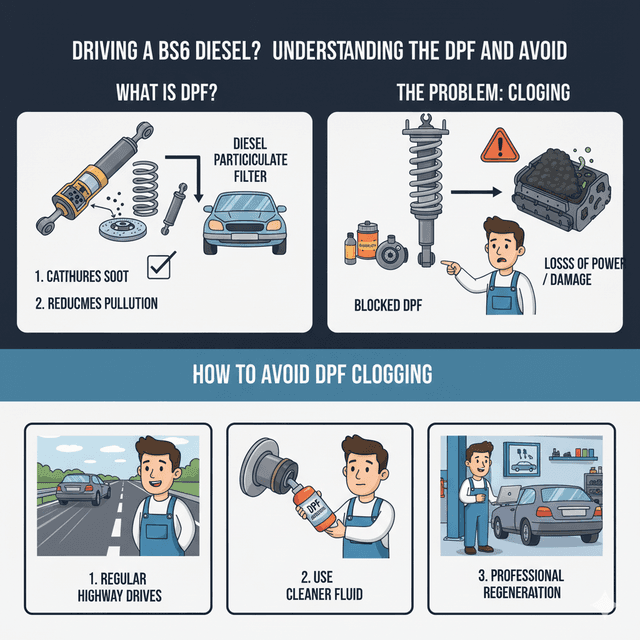
Driving a BS6 Diesel? Understanding the DPF and How to Avoid Clogging Issues

Drvyn
Content Writer
If you own a modern diesel car manufactured after the BS6 emission norms were implemented in April 2020, your vehicle is equipped with a sophisticated and expensive component called a Diesel Particulate Filter, or DPF. The DPF is crucial for reducing harmful emissions, but it requires a certain driving style to maintain its health. Understanding what it is and how it works can save you from a very costly repair bill.
What is a Diesel Particulate Filter (DPF)?
A DPF is a device integrated into the exhaust system of a diesel engine. Its job is to capture and trap the harmful soot (particulate matter) that is a byproduct of diesel combustion. Think of it as a very fine-meshed filter that catches these microscopic particles before they can be released into the atmosphere. This technology is what allows modern diesel engines to be significantly cleaner than their predecessors.
The 'Regeneration' Process: How the DPF Cleans Itself
The DPF can only hold a finite amount of soot. To clean itself out, it undergoes a process called 'regeneration'. During regeneration, the engine's computer alters its parameters to dramatically increase the temperature inside the DPF (to over 600°C). This extreme heat burns the trapped soot and converts it into a small amount of harmless ash.
There are two types of regeneration:
- Passive Regeneration: This happens automatically when you are driving at a sustained high speed, for example, on a highway. The high exhaust temperatures are naturally sufficient to trigger the cleaning process.
- Active Regeneration: If passive regeneration doesn't occur, the engine's computer (ECU) will take matters into its own hands. It will inject a small amount of extra fuel into the engine to intentionally raise the exhaust temperature and initiate the regeneration cycle. You might notice your engine RPMs are slightly higher at idle, or the engine fan is running loudly when this is happening.
The Problem: Clogging in City Driving
The DPF's biggest enemy is a driving cycle that consists only of short, slow, stop-and-go city trips. This type of driving does not allow the exhaust to get hot enough for passive regeneration to occur. The ECU will try to initiate active regeneration, but if you switch off the engine before this 15-20 minute cycle is complete, the process is interrupted. If this happens repeatedly, the soot builds up to a point where the filter becomes clogged.
Signs of a Clogged DPF
When the DPF gets clogged, you will see a specific DPF warning light on your dashboard. You may also notice:
- A significant loss of engine power (the car may go into 'limp mode').
- Reduced fuel efficiency.
- A strong smell of diesel from the exhaust.
- The engine's auto start/stop function being disabled.
If you see the DPF light, you should not ignore it. Your owner's manual will typically advise you to drive the car for 20-30 minutes at a steady speed of over 60 km/h to allow it to complete a regeneration cycle. If this doesn't clear the light, you will need to take it to a workshop for a 'forced regeneration' using a diagnostic tool. If left clogged for too long, the DPF can be permanently damaged, and a replacement can cost upwards of ₹1 lakh.
How to Keep Your DPF Healthy
- Take a weekly highway run: The best preventative measure is to ensure your car gets a good 30-40 minute run on an open road or highway at least once a week.
- Don't interrupt active regeneration: If you notice the signs of an active regeneration cycle, try to continue driving until it's finished.
- Use the correct engine oil: Modern diesel engines require special 'low-SAPS' (Sulphated Ash, Phosphorus, Sulphur) engine oil. Using the wrong oil can poison and permanently damage the DPF.
Understanding your BS6 diesel is key to its reliability. If you have a DPF warning light or are concerned about your driving style, our technicians can help. Book a diagnostic check-up with Drvyn for expert advice and service for your modern diesel vehicle.
Enjoyed this article?
Share it with your network
Join the Conversation
Share your thoughts and insights about this article