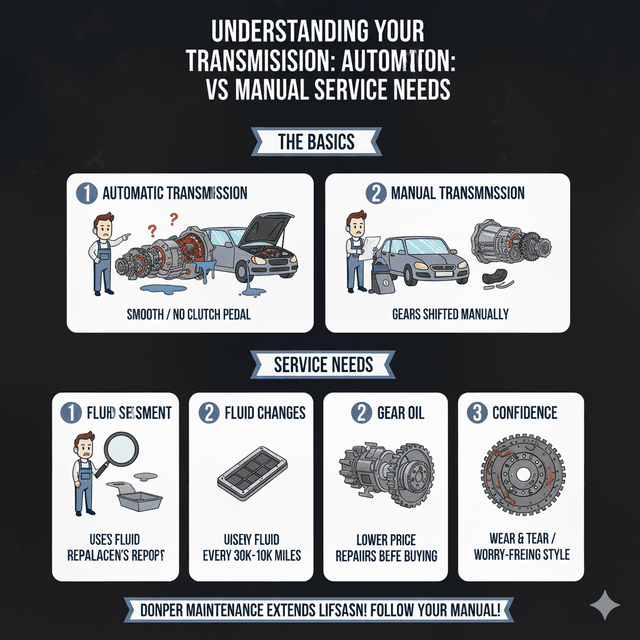
Understanding Your Transmission: Automatic vs. Manual Service Needs

Drvyn
Content Writer
The transmission is one of your car's most complex and mission-critical components. It's responsible for taking the power generated by the engine and delivering it to the wheels in a controlled way, allowing the car to move at different speeds. Whether you drive a modern automatic or a traditional manual, proper maintenance is the key to its longevity and performance. However, their internal workings and service needs are quite different. Let's explore the essentials of transmission care.
The Universal Importance of Transmission Fluid
In both automatic and manual transmissions, fluid is the lifeblood. It serves multiple crucial purposes: lubricating the countless moving parts to reduce friction and wear, cooling the unit to prevent dangerous overheating, and cleaning away tiny metal particles that are a natural byproduct of wear. In an automatic transmission, the fluid plays an additional, vital role as a hydraulic fluid, creating the pressure needed to engage clutches and enable seamless gear shifts.
Automatic Transmission Service: A Heat-Driven Need
What it involves: Automatic transmissions generate a tremendous amount of heat, which is the primary enemy of the Automatic Transmission Fluid (ATF). Over time, this heat breaks down the fluid's detergents and lubricating properties. The fluid becomes contaminated with microscopic particles from the clutch plates and metal shavings. A typical service involves either a 'drain and fill' (which replaces about half the fluid) or a more comprehensive 'fluid flush' using specialized equipment to exchange nearly all of the old, degraded fluid with new, clean fluid. The filter is also often replaced.
When to service: This varies greatly by manufacturer, from as early as every 50,000 kilometers to as late as 150,000 kilometers for some 'filled for life' units (though mechanics often recommend servicing these as well). It is absolutely critical to check your owner's manual and to use the exact type of ATF specified, as using the wrong fluid can quickly destroy the transmission.
Signs of trouble:
- Delayed or harsh engagement when shifting from Park to Drive.
- Hesitation, jerking, or slipping during gear shifts.
- A whining or buzzing noise that changes with engine speed.
- A burning smell, which indicates severely overheated fluid.
Manual Transmission Service: A Lubrication Focus
What it involves: Manual transmissions are mechanically simpler and generate significantly less heat than their automatic counterparts. Their fluid (often a thicker gear oil) primarily serves as a lubricant for the gears and synchronizers. Service is more straightforward and typically involves simply draining the old gear oil and refilling it with new fluid that meets the manufacturer's specifications.
When to service: The service interval for a manual transmission is generally much longer than for an automatic, often in the 80,000 to 120,000 kilometer range. However, cars used for performance driving or heavy towing may benefit from more frequent fluid changes.
Signs of trouble:
- Difficulty shifting into gear, or a 'notchy' feel.
- A grinding noise when shifting (this can also be a clutch or synchronizer issue, but low/old fluid is a common cause).
- The transmission jumping out of gear.
The Bottom Line: Prevention is Priceless
Transmission fluid service is one of the most important preventative maintenance tasks you can perform. It is infinitely cheaper than a transmission rebuild or replacement, which is consistently one of the most expensive repairs a car can need, often running into lakhs of rupees. Clean, fresh fluid keeps the intricate internal components cool, clean, and properly lubricated, dramatically extending the life of your transmission.
Protect one of your car's most expensive and essential components with proper, timely care. Whether you drive an automatic or a manual, our technicians are equipped to perform the correct transmission service for your specific vehicle. Book your transmission fluid service with Drvyn today and shift with confidence.
Enjoyed this article?
Share it with your network
Join the Conversation
Share your thoughts and insights about this article