Bumpy Ride? 5 Signs Your Car's Suspension Needs Checking

Drvyn
Content Writer
Your car's suspension system is a complex network of springs, shocks, struts, and linkages with two primary jobs: providing a smooth, comfortable ride for the occupants and keeping the tires firmly planted on the road for safe handling and braking. Over tens of thousands of kilometers, these components naturally wear out, leading to a gradual decline in both comfort and safety. Here are five common signs that your suspension system is worn and needs a professional inspection.
1. An Unusually Bouncy, Rough, or 'Floating' Ride
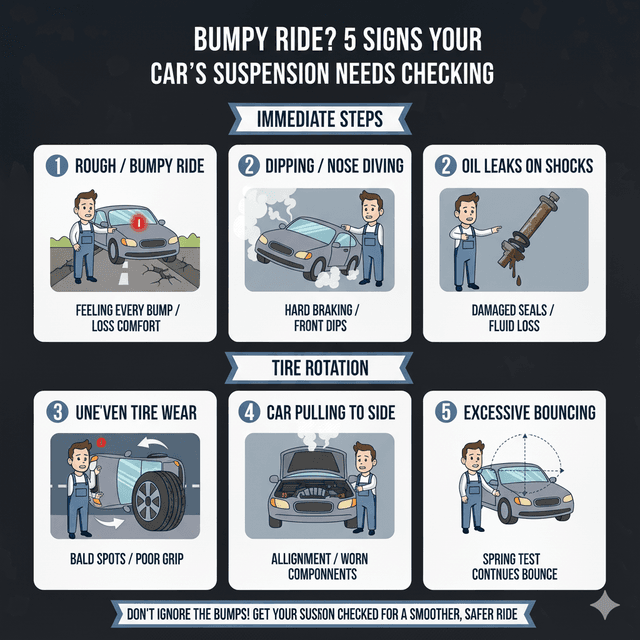
This is the most direct symptom of failing shock absorbers or struts. These components are responsible for damping the spring's oscillations. When they wear out, they lose their ability to control the bouncing. You'll start feeling every single bump and dip in the road much more harshly. After hitting a bump, you might also notice the car continuing to bounce up and down for a while instead of settling immediately. On the highway, you might experience a 'floating' sensation, as if the car is disconnected from the road.
2. 'Nose Diving' When Braking or 'Squatting' on Acceleration
Pay close attention to your car's body movement during acceleration and braking. If the front end 'dives' downward significantly when you brake firmly, it's a strong indication that your front shocks or struts are weak and can no longer support the vehicle's forward weight shift. This can dangerously increase your braking distance. Conversely, if the rear of the car 'squats' down noticeably when you accelerate, it points to worn rear shocks.
3. The Car Drifts, Sways, or Pulls During Turns
A healthy suspension system is crucial for stability through corners. If you feel your car's body 'rolling' or swaying excessively when you take a turn or change lanes, it means the shocks are no longer keeping the body stable against the centrifugal force. This creates a sloppy, uncontrolled feeling and can make the car difficult to handle in an emergency maneuver.
4. Uneven or 'Cupped' Tire Wear
A faulty suspension can have a devastating effect on your tires. When shocks or struts are worn, the wheels can bounce erratically as you drive, even on smooth roads. This causes a distinctive wear pattern often called 'cupping' or 'scalloping', where dish-shaped patches are worn into the tread. If you see this pattern, it's a near-certainty that your suspension components are the root cause, and replacing the tires without fixing the suspension will just ruin the new set.
5. Visible Leaks or Damaged Components
Take a moment to visually inspect the shock absorbers or struts at each corner of your vehicle (you may need a flashlight). These components are filled with hydraulic fluid. If you see an oily or greasy film covering the body of the shock/strut, it means its internal seals have failed and it is leaking fluid. A leaking shock has lost its damping ability and must be replaced. Also look for any cracked or broken bushings or mounts.
A healthy suspension is fundamental to a safe and comfortable drive. If your ride quality has gotten worse, don't just learn to live with it. Our technicians can perform a thorough inspection of all suspension components to restore your car's performance and safety. Book a suspension check with Drvyn and enjoy a smooth, controlled ride again.
Enjoyed this article?
Share it with your network
Join the Conversation
Share your thoughts and insights about this article