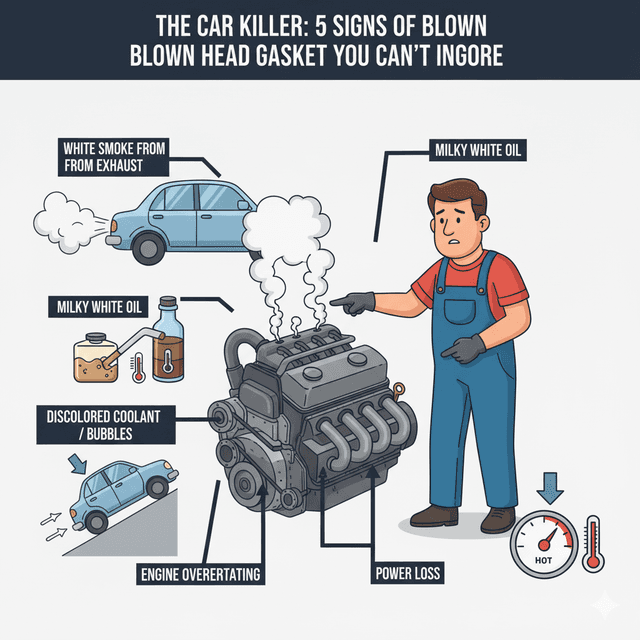
The Car Killer: 5 Signs of a Blown Head Gasket You Can't Ignore

Drvyn
Content Writer
In the hierarchy of car repairs, a 'blown head gasket' is one of the most feared phrases an owner can hear. It signifies a major, and often very expensive, engine problem. The head gasket is a critical seal between the engine block and the cylinder head, and its failure can lead to catastrophic damage if not caught early. Recognizing the early warning signs is crucial. Here are five key symptoms of a blown head gasket that you must not ignore.
What is a Head Gasket?
The head gasket is a thin but robust seal that has a very tough job. It must withstand extreme temperatures and pressures to keep three things separate: the engine's combustion chambers, the high-pressure oil passages, and the coolant (antifreeze) passages. When the head gasket fails or 'blows,' it creates a breach, allowing these three things to mix with disastrous consequences.
Sign 1: Engine Overheating
This is both a cause and a symptom of head gasket failure. If the gasket fails between a combustion chamber and a coolant passage, hot exhaust gases are forced into the cooling system. This pressurizes the system beyond its limits and introduces air pockets, leading to rapid and persistent engine overheating. If your car is constantly overheating even after fixing other cooling system parts, a blown head gasket is a strong possibility.
Sign 2: White Smoke from the Exhaust
If the gasket fails and allows coolant to leak into the combustion chamber, the coolant is burned along with the fuel. This creates a thick, white, sweet-smelling smoke that billows out of the exhaust pipe. This is different from the thin, vapor-like steam you see on a cold morning; this is dense smoke that persists even when the engine is warm.
Sign 3: Milky, 'Milkshake-like' Engine Oil
This is a classic and definitive sign. If the gasket fails between a coolant passage and an oil passage, the two fluids will mix. Coolant in the oil turns it into a milky, frothy, light-brown substance that looks like a milkshake. You can check for this by pulling out the engine oil dipstick. If the oil looks like this, it has lost all of its lubricating properties, and driving the car in this condition will rapidly destroy the engine's bearings.
Sign 4: Bubbles in the Radiator or Coolant Reservoir
With the engine running, if you can see a constant stream of bubbles appearing in the coolant overflow tank or when looking into the radiator (only do this when the engine is cool!), it's a sign that combustion gases are being forced into the cooling system. This is essentially a 'leak-down' test for a failed head gasket.
Sign 5: Unexplained Coolant Loss with No Visible Leaks
Is your coolant level constantly dropping, but you can't find any puddles or drips under the car? This 'mystery' coolant loss could mean the coolant is leaking internally into the engine's combustion chambers or oil system. It's being burned away or mixed with the oil rather than leaking onto the ground.
What to Do if You Suspect a Blown Head Gasket
Stop driving the vehicle immediately. Continuing to drive with these symptoms will almost certainly lead to complete engine failure. A head gasket replacement is a labor-intensive and expensive job, as it requires partially disassembling the engine. However, it is still far cheaper than a full engine replacement. A professional mechanic can perform a 'block test' or a 'leak-down test' to confirm the diagnosis.
This is one of the most serious engine problems you can face. If you notice any of these signs, prompt professional attention is critical. Contact Drvyn immediately to book a comprehensive engine diagnostic service with one of our expert partner garages.
Enjoyed this article?
Share it with your network
Join the Conversation
Share your thoughts and insights about this article