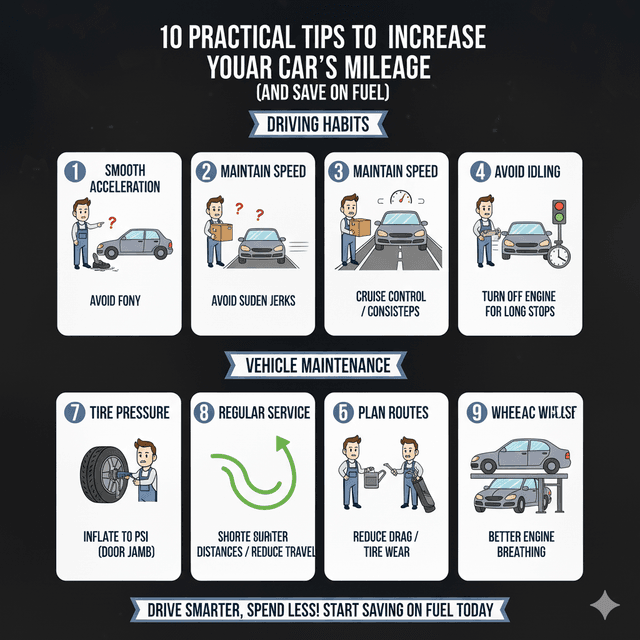
10 Practical Tips to Increase Your Car's Mileage (and Save on Fuel)

Drvyn
Content Writer
With fuel prices constantly on the rise, getting the most out of every litre of petrol or diesel is more important than ever. While your car's official ARAI rating is a benchmark, your real-world mileage is heavily influenced by your driving habits and vehicle maintenance. By making a few simple adjustments, you can significantly improve your car's fuel efficiency and save a substantial amount of money. Here are 10 practical tips to maximize your mileage.
1. Maintain Correct Tire Pressure
This is the simplest and one of the most effective tips. Underinflated tires have a larger contact patch with the road, which increases rolling resistance. This forces your engine to work harder—and burn more fuel—just to move the car. Check your tire pressure weekly and inflate them to the manufacturer's recommended PSI, found on the sticker in the driver's side doorjamb.
2. Smooth and Steady Driving
Aggressive driving is the biggest fuel-waster. Rapid acceleration, hard braking, and high speeds all consume massive amounts of fuel. Instead, practice smooth driving: accelerate gently, anticipate traffic flow to avoid sudden braking, and maintain a steady speed on the highway. Using cruise control on open roads is a great way to maintain efficiency.
3. Don't Idle Unnecessarily
An idling engine gets 0 kilometers per litre. If you are going to be stationary for more than 60 seconds (at a railway crossing or waiting for someone), it's more fuel-efficient to turn off your engine and restart it when you're ready to move. Modern cars are designed for this and it causes negligible wear on the starter.
4. Reduce Weight and Aerodynamic Drag
The heavier your car is, the more energy it takes to move. Remove any unnecessary heavy items from your boot or cabin. Additionally, external carriers like roof racks and boxes significantly increase aerodynamic drag, forcing the engine to work harder at highway speeds. Remove them when not in use.
5. Use the AC Judiciously
The air conditioning compressor puts a significant load on the engine, reducing fuel economy by as much as 10%. While necessary in India's climate, use it wisely. On pleasant days, use the fan or open the windows (at low city speeds). On the highway, using the AC is actually more efficient than open windows due to aerodynamic drag.
6. Follow Your Recommended Service Schedule
A well-maintained engine is an efficient engine. Regular servicing, especially timely oil changes and replacing clogged air and fuel filters, ensures your engine runs with minimal friction and breathes easily. A clean engine doesn't have to work as hard, which directly translates to better mileage.
7. Use the Recommended Grade of Engine Oil
Using the specific grade of engine oil recommended by your car's manufacturer (e.g., 5W-30) is crucial. Thicker, incorrect oil increases internal engine friction, making the engine work harder to pump it, thereby wasting fuel.
8. Plan Your Trips
Combine multiple errands into a single trip. A warm engine runs more efficiently than a cold one. Several short trips, each starting with a cold engine, will consume much more fuel than one longer, well-planned journey covering the same distance.
9. Shift Gears at the Right RPM
For manual car drivers, shifting gears at the optimal RPM is key. Shifting too late (revving the engine high) wastes fuel. Most modern cars have a gear shift indicator; otherwise, shifting between 2,000-2,500 RPM is a good general practice for economical driving.
10. Check Your Wheel Alignment
If your wheels are misaligned, they are essentially fighting each other, causing the tires to drag along the road instead of rolling freely. This 'scrubbing' increases resistance and wastes fuel, not to mention causing premature tire wear. Have your alignment checked annually.
Better mileage starts with a healthy car. Many factors contributing to poor fuel efficiency can be identified and corrected during a routine service. Book a comprehensive vehicle health check-up with Drvyn's experts and start saving on every kilometer you drive.
Enjoyed this article?
Share it with your network
Join the Conversation
Share your thoughts and insights about this article